


Does your business need a new oven, and are you considering a rotary oven?
If you own or operate a bakery, pastry shop, or pizzeria, you know how much baking quality impacts the final product. Therefore, choosing the right oven for your needs is crucial.
Among the many oven models on the market, the rotary oven undoubtedly offers the highest level of baking uniformity and production efficiency.
But let's take it step by step: continue reading to learn how a rotary oven works and why you should choose one for your bakery, pastry shop, or pizzeria.
What is a Rotary Oven?
A rotary oven is a professional oven primarily used in bakeries, pastry shops, and pizzerias.
What distinguishes a rotary oven from all other types of ovens is its rotating trolley, which moves during the baking process, ensuring that all products are heated evenly.
In static or deck ovens, the baking process can be uneven: for example, products closer to the oven walls or top may bake faster and become darker than those further from the heat source (e.g., near the door).
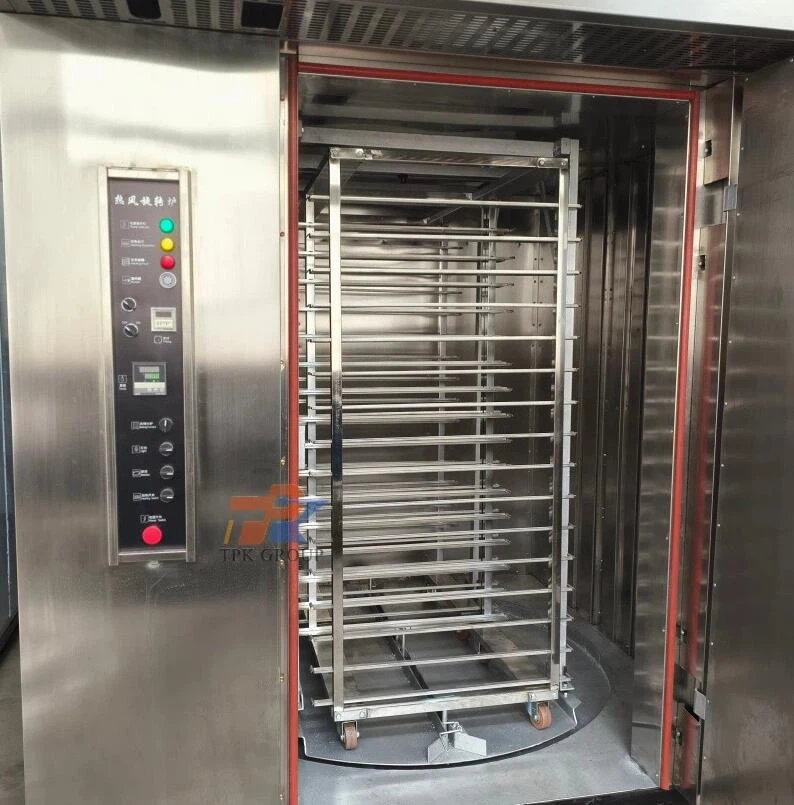
This problem is eliminated with a rotary oven – every product receives the same heat treatment regardless of its position.
Rotary ovens can be powered by gas, diesel, or electricity and allow for precise control of key parameters such as temperature, humidity, and rotation speed.
They are suitable for baking a wide variety of breads, croissants, breakfast pastries, pizzas, and leavened desserts. Furthermore, their design allows them to withstand high-intensity and continuous use.
How Does a Rotary Oven Work?
The operation of a rotary oven is based on three key aspects:
A rotating trolley is used to hold trays or racks. During baking, the trolley rotates slowly, ensuring even heating of each product and eliminating baking inconsistencies.
A forced convection system. The oven is equipped with powerful fans that circulate hot air throughout the baking chamber, maintaining a constant temperature.
Precise temperature and humidity control. A digital panel allows for customized baking programs and steam injection – ideal for specific types of bread or pastries.
Newer models also optimize energy consumption, helping businesses reduce production costs.
What are the advantages of a rotary oven?
Even Baking
One of the main advantages of a rotary oven is even baking. Because the rack rotates continuously, the heat is distributed evenly, ensuring that every product is baked in the same way.
Unlike traditional ovens, rotary ovens do not have "cold spots" or "hot spots." The final result is consistent regardless of the product being baked, eliminating the need for operators to manually rotate trays or move products during the baking process.
Shorter Baking Times
The convection and hot air circulation system speeds up the baking process. Compared to stationary or traditional ovens, rotary ovens can reduce the time required for each batch.
This means more batches can be completed in the same amount of time, which is crucial for businesses with high daily production volumes, especially during peak hours.
Higher Productivity
Compared to other types of ovens, the 64-tray rotary oven can bake more trays of products simultaneously.
This increases production efficiency without compromising product quality. Furthermore, precise programming and control of the baking cycle reduce errors and waste.


